Monthly Commentary
November 2024 Commentary
Year to Date S&P500 has gained 22.3% while NASDAQ has gained 24.7%. So, far a very good year for stocks.…
Uncategorized | February 1, 2026
The month of January finished on a good note for the stock market. The S&P 500 gained 1.6%, higher than its average monthly return, and the economy has remained resilient in the face of many uncertainties, including: AI, tariffs, leadership change in the Federal Reserve, interest rates, inflation, unemployment, etc. Throughout the month of January, a handful of important datapoints were released, most of which signaled positive news for the U.S. economy. In sum, our economy is experiencing (1) stabilizing unemployment, (2) stickier inflation, (3) record GDP growth, corporate profits, and cash flow, and (4) a broadening bull market.
When weighing the probability of future rate cuts, inflation and unemployment are the two most important pieces of data. Although the unemployment rate has stabilized, inflation appears to be stuck around 3%, higher than the Fed’s 2% target. With inflation stuck at higher levels, the Fed decided to leave rates unchanged in their January meeting. However, the market still anticipates between 1 and 3 rate cuts this year, depending on the source. Going forward, the best-case scenario for lowering rates would be a dip in the rate of inflation.
Interestingly, Kevin Warsh, the former Fed governor who was named to succeed Jerome Powell as the chairman of the Fed, is a strong proponent of the theory that developments in AI will boost productivity and push-down inflation, which will open the door for further rate cuts. If his theory of a simultaneous jump in productivity and slump in inflation is correct, stock prices would react favorably. This is because, in this case, all three forces would be moving in favor of the stock market.
1. An increase in productivity indicates that companies can produce the same output at a smaller cost. This is almost entirely reflected in higher profit margins and earnings growth.
2. Lower inflation supports stock prices in every aspect of production. Lower input costs typically support higher and more stable profit margins, and lower costs to the consumer support higher consumer spending, resulting in accelerating revenue and earnings growth.
3. Rate cuts are almost always positively received by the stock market, as lower borrowing costs support healthier margins and lower the attractiveness of the bond market.
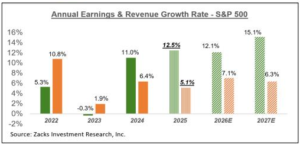
Data also indicated that the U.S. economy is growing at a fast rate, as interpreted by Yardeni Investment Research. They found that U.S. GDP growth jumped to 4.4% in Q3-2025 and is tracking at 5.4% in Q4-2025, all while corporate profits and cash flow have grown to record levels. With capital spending also nearing record highs, growth has been primarily fueled by higher profits, which are anticipated to continue growing and may lead to further growth in stock prices. Data from Zacks Investment Research suggests S&P 500 earnings growth of 12.5% in 2025, and they forecast growth of 12.1% in 2026 and 15.1% in 2027.
Past performance is not indicative of future results. Risk is inherent in any investment.
Lastly, the “broadening bull market” that we have written about extensively over the last 6 months is coming to fruition. As a reminder, this means that, while we are still confident in the Magnificent 7, forecasts over the last year indicated that the other 493 stocks that compose the S&P 500 would bridge the gap with the dominant Mag 7. So far this year, that is exactly the case, with Energy, Basic Materials, Industrials, Consumer Staples, and Communication Services reigning as the top five performing sectors.
At Worcester Advisors, we continue to recommend investment in well diversified portfolios of high-quality companies with consistent earnings growth as the safest method of achieving capital growth.
Your team,

KEEP READING