Monthly Commentary
November 2024 Commentary
Year to Date S&P500 has gained 22.3% while NASDAQ has gained 24.7%. So, far a very good year for stocks.…
Uncategorized | April 1, 2026
The month of March, for the most part, was unpleasant for investors. The S&P 500, NASDAQ, and Dow Jones Industrial Average all slipped roughly 5%. Late in the month, both the NASDAQ and Dow officially entered correction territory, which is defined as a decline of 10% or more from recent peaks. The S&P 500 however has not yet crossed the 10% threshold to categorize its decline as a correction.
Of paramount concern to the stock market is the war in Iran. The closure of the Strait of Hormuz has been the most significant factor in the decline of stock prices. Stretching 104 miles long and 21 miles wide at its narrowest point, the Strait of Hormuz connects the Persian Gulf to the Gulf of Oman. In terms of oil transportation, the strait is the second largest transportation route in the world, facilitating the transit of nearly 20 million barrels of oil per day, which represents 20% of global oil trade. As Iran has the longest coastline of the eight countries that border the Persian Gulf, it has the unique ability to disrupt the free flow of commodities. After the United States and Israel coordinated attacks against Iran, the Iranian government responded by closing the Strait of Hormuz. The price of oil surged on the news, with Brent Crude reaching $119.5 per barrel on March 9, and pushed stock prices down. An oil shock is always poorly received in the stock market as it negatively impacts both inflation and economic growth. An increase in oil prices generally pushes inflation higher, but the rising transportation and production costs associated with the price increase hinder economic growth and profits. If oil prices remain elevated for an extended period and consumer spending cannot support economic growth, the result can be stagflation.
However, President Trump has recently reaffirmed the government’s aspirations to exit the country within 2-3 weeks, allowing for a reopening of the Strait, which would reel in oil prices and boost stock prices. Analysts from many research houses relay a similar message, with Ed Yardeni from Yardeni Research suggesting that the S&P 500 may have bottomed on Monday after a pullback of 1.9%, and the research team from Morgan Stanley claiming that the market correction nears its final stage.
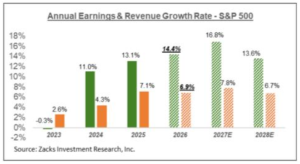
Regarding the economy, a recent batch of upbeat economic data has been released which supports an optimistic outlook for the stock market. Initial unemployment claims dropped last week to 202,000, layoffs for the month of March by US employers are down 78% from last year, and 178,000 jobs were added during the month, much higher than the expectation of 65,000. On the earnings front, the United States has seen five consecutive quarters of double-digit earnings growth. Most importantly, Q4 2025 revenue growth of 9% indicates that earnings growth of 14.2% for the quarter was fueled by genuine consumer demand and AI productivity gains, not simply cost cutting. The full year forecast from Zacks Investment Research suggests a continuation of the trend of double-digit
earnings growth, with their 2026 forecast at 14.4%. Consistent earnings growth at this rate would support a meaningful increase in stock prices, which is relayed by Yardeni’s forecast of 7,700 for the S&P by the end of 2026.
At Worcester Advisors, we continue to recommend investments in well diversified portfolios of high-quality companies with consistent earnings growth as the safest method of achieving capital growth.
Your team,

KEEP READING